Tuesday, October 14, 2008

Santa Anita's Historic Decorative Frieze

One of the most recognizable architectural details of beautiful Santa Anita Park is the famous frieze of white running horses that adorns the back of the stands in a perfect flow. The frieze complements the art-deco style created by architect Gordon Kaufman in the 1930's.

Santa Anita Park Frieze
A little-known aspect of the frieze is that, in one of the panels, a jockey is depicted falling off a horse (see photo below). It is said that the falllen jockey was meant to depict the great George Woolf, who died at the age of 35 following a spill at Santa Anita.

Santa Anita Park FriezeDuring the running of the fourth race on January 3, 1946, Woolf fell from his horse as they rounded the clubhouse turn, suffering a concussion. He was taken to St. Luke's Hospital in Pasadena, where he died the next day. George Woolf was a diabetic, and it was generally believed that he suffered a diabetic fainting spell before falling from his mount.

Known as "The Iceman" becuase of his renowned cool and patience while waiting for his horse to make the right move in a race, George Woolf was one of the premier jockeys of his era. In 1935, he made history when he rode Azucar to victory in the Santa Anita Handicap - the first horse race worth $100,000.

When asked what was the best racehorse he ever rode, George Woolf answered immediately, "Seabiscuit." In the 2003 film, Seabiscuit, jockey Gary Stevens played the famed Woolf. Stevens was the 1996 recipient of the George Woolf Memorial Jockey Award, an award that has been given annually since 1950 to a North American jockey who demonstrates high standards of personal and professional conduct both on and off the racetrack.

A bronze statue of George Woolf was erected in his honor, and stands in the paddock at Santa Anita Park. A photo of the statue is shown below.


The Iceman's Derby

George Woolf bought a restaurant on Huntington Drive in Arcadia, in 1938, and renamed it in honor of the Kentucky Derby. He promptly decorated the walls of "The Derby" with racing memorabilia, most of which remains to be enjoyed by patrons at The Derby today. Woolf lived on the second floor above the restaurant, and many believe that his ghost haunts the restaurant.

Tuesday, February 17, 2009

Gary Stevens to Announce George Woolf Award Winner

"The Iceman"

Hall of Fame jockey Gary Stevens will announce the winner of the 2009 Santa Anita George Woolf Memorial Jockey Award live on HRTV, this Thursday at approximately 2:05 PM (pst). The award has been given annually since 1950 to a North American jockey, chosen by his or her peers, who demonstrates high standards of personal and professional conduct both on and off the racetrack.

This year's finalists are Gary Baze, Calvin Borel, Javier Castellano, David Flores and John Velazquez.

It is fitting that Stevens will make the announcement. Not only is he a former recipient of the Woolf Award (1996), but he also played the famed Woolf in the 2003 film Seabiscuit. Stevens, now retired, works as a full-time analyst on HRTV.

The trophy is a replica of a full-size bronze statue of George Woolf that stands in the paddock at Santa Anita Park. Woolf, who was revered by his fellow jockeys for his riding ability, competitiveness, and professionalism, died at the age of 35 following a spill at Santa Anita.

During the running of the fourth race on January 3, 1946, Woolf fell from his horse as they rounded the clubhouse turn, suffering a concussion. He was taken to St. Luke's Hospital in Pasadena, where he died the next day. George Woolf was a diabetic, and it was generally believed that he suffered a diabetic fainting spell before falling from his mount.

Known as "The Iceman" because of his renowned cool and patience while waiting for his horse to make the right move in a race, George Woolf was one of the premier jockeys of his era. In 1935, he made history when he rode Azucar to victory in the Santa Anita Handicap - the first horse race worth $100,000.

Tuesday, February 9, 2010

George Woolf Memorial... A Caliente Tradition


A guest post by David J. Beltran

Every winter since 1950, jockeys select one of their peers to receive the prestigious George Woolf Memorial Award at Santa Anita. The list reads like a roll call for the Hall of Fame. Riders like Shoemaker, Arcaro, Longden and Pincay are among those who have been awarded this trophy. While most racing fans are aware of the award at Santa Anita, many don’t realize that Agua Caliente also had its own version of the George Woolf Memorial Award as well.

Daily Racing Form announces the 1965 running of the George Woolf Memorial Handicap.

With Caliente offering the only Sunday racing in the region, track General Manager and President John Alessio suggested that the fans at Caliente would love to see a host of such top riders as Arcaro and Longden come down and ride at Caliente. With the help of Jockey’s Guild Director Bert Thompson, Alessio made all the arrangements to host such a gallery of top jockeys.

Jockeys assembled at Caliente for the Woolf Memorial: (left to right) Eddie Arcaro, Wiiliam Shoemaker, Merlin Volzke, Walter Blum, William Harmatz, Jockey's Guild President Bert Thompson, Pete Moreno, Jimmy Nichols, Gordon Glisson, Johnny Longden, Ray York, Mel Peterson and Rojelio Trejos.

“It was a lot of fun,” said former jockey Donald Pierce in a 2003 interview. “Alessio put it all together, and we would make the trip down to Tijuana, have dinner at the track after the races, watch the greyhounds and then stay overnight and enjoy the drive home."

Jerry Lambert winning the 1968 running. Rider on the second-place horse is Laffit Pincay, Jr.

First run in 1947, a year after the untimely death of The Iceman, the inaugural running of the George Woolf Memorial Handicap was won by Johnny Longden. Set at 1 1/16-miles, Woolf Memorial featured many of the regular jockeys from the current Santa Anita meeting plus one or two top riders at Caliente. And the draw for mounts was held in the Arcadia jockeys room.

The race featured a full field plucked from the handicap ranks at Caliente. Most riders would amble about the Caliente Clubhouse, while others preferred to ride rather than wait for the feature race. While the purse was nothing compared to what was offered north of the border, it was bolstered by the gifts that came along with the winner’s circle trophy -- a saddle and whip with a plaque featuring the previous winners of the race.


Alex Maese in the Jockey's Room at Caliente.

Some of the game’s greatest riders ventured down to Tijuana to ride at Caliente. Jockeys like Arcaro, Longden, Shoemaker, Westrope, and Volzke were among the many that made the trip back to their old stomping grounds at Caliente to honor George “The Iceman” Woolf.

Photos: David Beltran collection.

David J. Beltran was born in Chula Vista and raised in San Diego and Tijuana. He has been attending the races since he was an infant, both at Caliente and the Southern California race tracks. Beltran is the author of the book The Agua Caliente Story (Eclipse Press 2004), a correspondent to Caballo, a racing magazine in Mexico, and a writer for the Argentine racing daily, Turf Diario. He recently published an article in HorsePlayer magazine covering betting on South American imports. Beltran also breeds Thoroughbreds and is a blood-stock agent specializing in Argentinean racing and breeding stock. He lives in Chula Vista with his wife, daughter, and two dogs. His previous posts explored the origins of the Big 'Cap and the "5-10" wager at Caliente.

Thursday, November 20, 2008

George Woolf Jockey Award Finalists Named

Santa Anita Park today announced a list of five finalists for the 2009 George Woolf Memorial Jockey Award. Jockeys named were Gary Baze, Calvin Borel, Javier Castellano, David Flores and John Velazquez. The nominees will be judged by their peers, with the winner being announced in January.

The Woolf Award has been presented annually by Santa Anita since 1950 to a North American jockey who demonstrates high standards of personal and professional conduct both on and off the racetrack. The trophy is a replica of a full-size bronze statue of George Woolf that stands in the paddock at Santa Anita Park. Woolf, who was revered by his fellow riders for his riding ability, competitiveness, and professionalism, died at the age of 35 following a spill at Santa Anita.

Known as "The Iceman" becuase of his renowned cool and patience while waiting for his horse to make the right move in a race, George Woolf was one of the premier jockeys of his era. In 1935, he made history when he rode Azucar to victory in the Santa Anita Handicap - the first horse race worth $100,000.

The Woolf Award will be presented during the Santa Anita Winter/Spring meeting, which runs from Dec. 26, 2008 through Apr. 19, 2009.

Wednesday, March 4, 2009

Velazquez to Receive Santa Anita's Woolf Award Sunday

Statue of George Woolf, Santa Anita paddock.

Edited Santa Anita press release.


John Velazquez
, winner of the 2009 Santa Anita George Woolf Memorial Jockey Award, will receive the prestigious honor Sunday, March 8, in a ceremony between races in the Santa Anita winner’s circle. Velazquez will be joined by many former winners of the award, which was instituted by Santa Anita in 1950. By a vote of his peers nationwide, Velazquez was selected over four other finalists: Gary Baze, Calvin Borel, Javier Castellano and David Flores.

The winner’s trophy is a replica of the full-size statue of George Woolf which adorns Santa Anita’s Paddock Gardens area. The statue was created through donations from the racing public after Woolf’s death following a spill at Santa Anita on Jan. 13, 1946.

Woolf, who was regarded as one of the greatest big-money riders of his era, was affectionately known as “The Iceman” in reference to his cool under pressure, and was revered by his colleagues as a fierce competitor and consummate professional. The award, which honors and recognizes riders whose careers and personal character earn esteem for the individual and the sport of Thoroughbred racing, is regarded as one of the most prestigious honors in the racing world.

Thursday, February 19, 2009

And the Winner Is... John Velazquez!

John Velazquez was named 2009 winner of the George Woolf Memorial Jockey Award on a live HRTV broadcast today. Making the announcement was retired Hall of Fame jockey Gary Stevens, himself a Woolf Award recipient in 1996.

Velazquez, 37, currently rides at Gulfstream Park in Florida. In 1990, the native of Puerto Rico began riding in New York, where he now lives with his wife, Leona. Velazquez is a two-time Eclipse Award winner and has won six Breeders' Cup races.

The date of the Woolf Award ceremony has yet to be announced, but it is traditionally presented at Santa Anita in late March or early April.

Friday, November 21, 2008

David Flores Will Ride Speedy Bob Black Jack in Vernon O. Underwood


David Flores, recently nominated for this year's prestigious George Woolf Award, has the call on Bob Black Jack in the 28th running of the Grade 3 Vernon O. Underwood Stakes at Hollywood Park on Saturday. Bob Black Jack, who established a world record of 1:06.53 for six furlongs at Santa Anita in January, returns to the races to face older horses at his record distance.

Bob Black Jack, a son of Stormy Jack, finished third in the San Felipe, then second to Colonel John in the Santa Anita Derby, earning a trip to the Kentucky Derby, where he set the pace before tiring to finish 16th. Trained by Jim Kasparoff for owners Jeff Harmon and Tim Kasparoff, Bob Black Jack has won 3 of 8 starts for earnings of $442,925.

Flores was among five finalists for the 2009 Woolf Award announced by Santa Anita Park yesterday. He has long been regarded as one of Southern California's top jockeys and is known for a level temperament and coolness under fire. A native of Mexico, Flores won his first race at Agua Caliente racetrack on March 5, 1984. He has won more than 3,180 races including three Breeders' Cup races. Flores believes in giving back to his community and hosts his own golf tournament each summer at Del Mar to raise funds for the charity "Orphans of Tijuana."

Here's the complete field for Saturday's feature:

Vernon O. Underwood S. (G3)
November 22, $100,000, 3yo & up, 6f, Hollywood Park, 3:35 PM PT

PP Horse              Sire            Jockey          Wt.  Trainer
1. Wiredfortwotwenty Greatness Joseph Talamo 116 Brian Koriner
2. Six Pack Abs Forest Wildcat Tyler Baze 118 John Sadler
3. Noble Court Doneraile Court Mike E. Smith 122 John Sadler
4. Master Daniel Broken Vow Rafael Bejarano 114 Doug O’Neill
5. Bob Black Jack Stormy Jack David Flores 122 James Kasparoff
6. Johnny Eves Skimming Garrett Gomez 122 Jay Robbins
7. Northern Soldier Yankee Victor Aaron Gryder 118 Brian Koriner

Friday, February 22, 2013

Celebrate Oscar Sunday with a Horse Racing Movie


A Guest Post by Dark Horse Bet

With Oscar Sunday just days away, movie hype and Hollywood fever is in the air. Who will take home the award for best performance? Which storyline will receive the Oscar for best picture? What will the celebrities be wearing to the big event?

Though none of the films in this year’s best picture lineup involve a horse racing theme, the horse racing community is no stranger to the big screen. From true stories retold to fictional renditions of adventures at the track, many movies have captured the spirit of the sport leaving audiences touched and new generations inspired.  As a nod to the 85 Academy Awards and horse racing fans alike, we have compiled a list of 10 horse racing movies to check out next time you are surfing Netflix, Redbox or your local library’s film section.

1.) Seabiscuit (2003)


Based loosely on the true story of a Depression-era racehorse, Seabiscuit follows the unlikely racing career of an overlooked thoroughbred and his too-tall jockey, played by Tobey Maguire. These misfits become the classic underdog team, finding unexpected success that not only puts them on the tracks with the big boys, but also inspires a nation looking for hope amidst troubling  economic turmoil. Hall of Famer, jockey Gary Stevens, played the role of jockey George Woolf, bringing the race scenes to life in an invigorating way.

2.) The Lemon Drop Kid (1951)


Bob Hope plays New Yorker, Sidney Milburn, aka “The Lemon Drop Kid,” a swindler touting racehorses at a track in Florida. After he convinces a woman to change her bet to a horse that finishes in last place, the woman’s outraged, mobster beau demands a $10,000 compensation to make up for his lost potential earnings, giving “The Kid” until Christmas Eve to turn in the cash. The real-life 1999 Belmont Stakes winner, Lemon Drop Kid, was affectionately named after this comedy film.

3.) Dreamer: Inspired by a True Story (2005)


Inspired by the true story of race horse Mariah’s Storm, Dreamer chronicles the life of fictional horse Sonador, an aspiring winner who faces a severe injury that stands to jeopardize her racing career. In the film, young horse-lover, Cale Crane, (played by Dakota Fanning) is the daughter of horse trainer Ben, (played by Kurt Russell) and witnesses Sonador fall on the track. The girl insists that that her father rescue the horse from being put down. As Sonador successfully progresses through rehabilitation, the father and daughter pair restore their strained relationship.

4.) Secretariat (2010)


Secretariat is remembered not only as the 1973 Triple Crown Winner, but also as one of the greatest thoroughbred horses of all time. This film relives the tale of his victorious road and race to the top, integrating the important role of owner Penny Chenerey (played by Diane Lane) who did not lose faith in the horse known at the barn as “Big Red.” Real-life Chenerey makes a cameo appearance in the movie.

5.) A Day at the Races (1937)


Starring the three Marx Brothers, this classic comedy tells the story of three doctors who try to save a woman’s farm by winning a big race with her horse. Running into some inconvenient problems along the way, the film has racing flavor mixed with musical entertainment and a lot of laughs by this famous family comedy act.

6.) The Black Stallion (1979)


Based on the 1941 children’s novel by Walter Farley, this film is about a young boy, who, when traveling with his father, is shipwrecked on a desert island with no other survivors except the mysterious Arabian stallion traveling with them. The boy and horse develop a friendship, and after rescued, return home where they meet a trainer who helps the human/equine team prepare to race against the fastest horses in the world.

7.) National Velvet (1944)


This film starring Elizabeth Taylor and Mickey Rooney takes place in Sussex, England where twelve-year-old Velvet (Taylor) wins an energetic horse in a raffle, and with the help of drifter and former jockey Mi Taylor (Rooney), trains the gelding to race in the Grand National Steeplechase. The film is ranked 9th on the American Film Institute’s list of 10 greatest films in the sports genre.

8.) Phar Lap (1983)


Another Depression-era champion, thoroughbred Par Lap dominated Australian horse racing during a time of economic despair. His winning career inspired the 1983 film that retells the story of the racehorse that made it to the top through the commitment of a local stable boy who bonded with him, and how a mysterious illness ended it all.

9.) Shergar (1999)


This film is an interpretation of the true story of acclaimed Irish racehorse Shergar, who won the 1981 Epsom Derby by an impressive 10 lengths, then was later abducted by who many theorized to be Irish Republican Army terrorists seeking ransom for weapons. Though the true fate of Shergar is still sadly unknown, the Hollywood portrayal tells the story of an orphan boy working on the farm who decides to save the horse by fleeing with him.

10.) Hidalgo (2004)


Based loosely on the story of American distance Rider Frank Hopkins and his horse Hidalgo, the film recounts the 1891 tale of how Hopkins and Hidalgo were summoned by a wealthy man to compete as the first American and his mustang in the legendary “Ocean of Fire,”a 3,000-mile race and grueling adventure across the Najd desert in Arabia, restricted only to pure-bred Arabian horses. Hopkins and Hidalgo eager for the challenge attempt to accomplish the impossible.

As we have seen, horseracing movies have been on the scene for decades. The sport offers many unique examples of victory, defeat, trial, disappointment and triumph, and Hollywood films have become one way to explore these stories further and pass them on to younger generations. Whether you are interested in renting one of these movies-- or one of the countless others-- next time you find yourself amidst a slow day at the tracks, maybe a cinematic break will help you find your fix. But when the gates open and the bell cues the start of a new race, we hope you will wager and win with us at Dark Horse Bet, the fastest growing community of online horse-playing.

For a look at what Santa Anita horse trainers are watching, see this previous post!

Friday, March 6, 2009

Cowboy Cal Schooling for the Santa Anita Handicap


Cowboy Cal schooled Friday morning for trainer Todd Pletcher at Santa Anita in preparation for Saturday's $1 million Santa Anita Handicap. Cowboy Cal, winner of the Grade 2 Strub Stakes at Santa Anita on Feb. 7, was schooling with stablemate Monba. Monba and Cowbay Cal were first and second in the Grade 1 Bluegrass Stakes at Keeneland last April.

John Velazquez, who has the mount on Cowboy Cal in the Big 'Cap, will stay over for a special ceremony on Sunday, when he will receive the coveted George Woolf Award.

Wednesday, July 8, 2009

Southern California Trainers Offer Praise for Merlin Volzke

Trainer Bruce Headley holds a photo montage of Volzke's six wins in one season aboard Fast and Lucky.

This morning out at Clockers’ Corner, Santa Anita, when I asked a few longtime trainers what they remembered about Merlin Volzke, I heard an outpouring of praise for the man who will be the recipient of the Laffit Pincay Jr. Award at Hollywood Park this weekend. In an industry where everyone’s got an opinion, it was difficult indeed to find someone with anything other than a good opinion of Volzke.

Mel Stute, for whom Volzke rode many races, put it best: “In my opinion, anything you could say about him would have to be nice.” Stute then added, “He was never in the limelight for doing anything wild.”

Volzke will be the first jockey to receive the Pincay Award, which will be presented by the Hall of Fame jockey himself during Saturday’s Hollywood Gold Cup program.

He was apparently so well known for his integrity as a rider, that several trainers I spoke to said that Volzke was notorious for never getting “set down.” In fact, the general consensus was that he only received one suspension in his entire riding career – and a minor one at that.

“He was a good advertising for racing,” said George Vogel.

Bruce Headley, for whom Volzke rode in the 1970s, was also eager to offer words of praise.

“He helped me more than any other jockey in the days when I was working my own horses,” said Headley. Headley proudly displays some of the winning photos from those days, noting that Volzke won 8 of 11 races on Fast and Lucky for him in 1974. Six of those wins came in one season at Golden Gate Fields. The other two were the Camellia and Native Diver Stakes at Bay Meadows the same year.

It seemed that everyone wanted to share a story about Volzke. Hot walker Danny Kaplan recalled an encounter with Volzke in 1977, when Kaplan rode his first race at Vallejo. Volzke, who was nearing retirement and rode in the same race, came up to Kaplan afterwards and asked, “How did it feel?” Kaplan said, “I asked him what he meant, and he said, ‘Riding your first race! I can’t remember.’”

Volzke began his professional riding career in the 1940's and was leading jockey at Longacres in 1948. His major victories in California included an upset win on Hanalei Bay in the 1970 Hollywood Derby, the 1961 El Camino Handicap on Native Diver, the 1954 San Pasqual Handicap on Phil D., the 1954 Santa Anita Maturity on Apple Valley, the 1968 San Gabriel Handicap and 1969 Arcadia Handicap on Rivet, the 1969 La Jolla Handicap on Eagle Fly, and the 1969 San Miguel Stakes on Mr. Joe F.

Volzke, now 83, retired as a jockey in 1979. He then worked as a steward at Los Alamitos and Bay Meadows before retiring in 2005. He was the recipient of the George Woolf Memorial Jockey Award in 1958 and the Jackie Robinson Memorial Award at Bay Meadows in 1975. He now lives in Pinole, Calif., with wife Catherine of 56 years and daughter Eileen.

The Pincay Award is presented annually to an individual who has served the sport with integrity, extraordinary dedication, determination and distinction. Congratulations to a recipient who so obviously deserves the honor!

Sunday, February 28, 2010

John and Betty Mabee had Connection to Early Caliente Racing


A guest post by David J. Beltran

The recent passing of Betty Mabee closed an era in Thoroughbred racing in California. Well known for their Golden Eagle Farm, John and Betty Mabee bred a long list of runners that have found a place in the hearts of many California racing fans. Although linked with their farm, they did not come into the game armed with what would eventually turn into one of racing’s formidable nurseries. Like many from their era who got into the racing game, the Mabees had a string of horses at Agua Caliente racetrack in Tijuana, Mexico.

Many Californians made the most of the affordable rates and the horsemen who worked at Caliente, and the one-mile oval was a safe dirt surface. The Mabees had a string trained by either Lawrence “Swede” Jenner or Cliff Clayton. Racing at Caliente afforded not only the Mabee family to be part of the game, but many others as well.

Upon reading of her passing, I quickly remembered having a photo of John and Betty Mabee in the winner’s circle one Sunday afternoon on the last weekend of July 1971. Little did they know that they had just won the last feature race at Caliente, for the track’s Grandstand and Clubhouse would be destroyed in a fire two days later.

It is memories of times like these that remind me the photo and memorabilia collection I have is really not mine… but it belongs to all that enjoy the races.

David J. Beltran and family wish to express our condolences to the Mabee family.

Photo: David Beltran collection.

David J. Beltran was born in Chula Vista and raised in San Diego and Tijuana. He has been attending the races since he was an infant, both at Caliente and the Southern California race tracks. Beltran is the author of the book The Agua Caliente Story (Eclipse Press 2004), a correspondent to Caballo, a racing magazine in Mexico, and a writer for the Argentine racing daily, Turf Diario. He recently published an article in HorsePlayer magazine covering betting on South American imports. Beltran also breeds Thoroughbreds and is a blood-stock agent specializing in Argentinean racing and breeding stock. He lives in Chula Vista with his wife, daughter, and two dogs. His previous posts explored the origins of the Big 'Cap, the Woolf Memorial, and the "5-10" wager at Caliente.

Tuesday, December 8, 2009

The Original Big 'Cap: South of the Border

A guest post by David J. Beltran

When Einstein crossed the finish line to win the 2009 $1-million Santa Anita Handicap, he added his name to a list of champions that have made it Santa Anita’s signature race. Many people don’t know that the concept for the storied Big ‘Cap actually has its roots in Mexico, with the Coffroth Handicap.
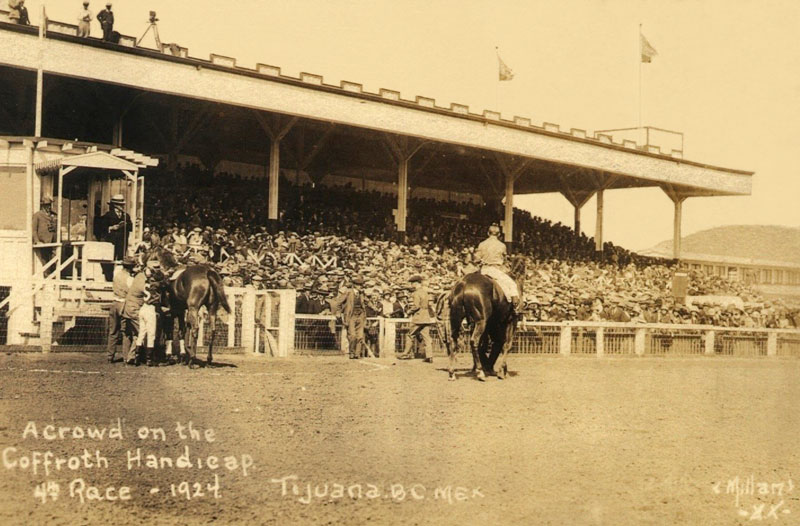
Coffroth Handicap 1924
A crowd filled the stands of Tijuana Racecourse for the 1924 Coffroth Handicap.

The Coffroth Handicap, started at Tijuana Racecourse, was named after the track’s president, San Francisco boxing promoter James "Sunny" Coffroth. The first running of the Coffroth only held a purse of $5,000 to the winner, but soon the race would increase in value when it was suggested by Tijuana’s presiding steward, George W. Schilling, that the purse should increase by $10,000 each year.

Outside of Oriental Park in Havana, Cuba or The Fair Grounds in Louisiana, winter racing at the time was non-existent in the United States. There was a revolution simmering in Mexico, and the Juarez racetrack had closed its doors. Tijuana racetrack was poised for serious growth thanks in part to a supportive social and governmental environment. First there was no competition from any other racetrack that operated during the winter months. Secondly, Prohibition had inspired many an American to venture into Mexico to misbehave, spend a little money and gamble at the various casinos that dotted the U.S-Mexico border. And with the Mexican government declaring the northern region of Baja California a free trade zone, American investors were able to set up business to support the border region of San Diego/Tijuana as a winter vacation getaway. With Coffroth’s Blue Fox Casino funding the racetrack venture the value of the Coffroth Handicap seemed to have no limits.

The early runnings of the Coffroth Handicap featured the best local runners from the current winter meet, but it was not until 1924 that the first BIG horse was lured into Mexico. His name was Exterminator -- the winner of the 1917 Kentucky Derby. “Old Bones,” as he was affectionately called, made a devastating debut south of the border to win an allowance race and was heavily favored to win the $40,000 Coffroth Handicap, but the best he could manage was a fourth-place finish.

With each subsequent running, the Coffroth Handicap not only increased in value but in the fields it attracted, such as top handicap horses Atherstone, Sunspero, Carlaris and Princess Doreen. The race reached its goal of $100,000 in 1928 when Crystal Pennant beat 17 rivals.

Crystal Pennant 1928
Crystal Pennant after winning the 1928 Coffroth Hadicap.

The following year, Golden Prince took home the $113,000 prize when he forged home ahead of 21 competitors. Sadly this was to be the final racing season at the old Tijuana racecourse. The racing permit was bought out by the management of the Agua Caliente Casino and Resort, and racing was to be held at the new $2.9-million dollar Agua Caliente Jockey Club.

The “new racetrack” simply transferred over the old racing calendar and proceeded. The inaugural running of the Agua Caliente Handicap in 1930 attracted 1928 Preakness winner, Victorian. Highweighted at 126 pounds, Victorian did not find the weight an obstacle as he went on to an easy victory.

Agua Caliente Handicap Post Parade 1930
Post parade for the first running of the $100,000 Agua Caliente Handicap, March 23, 1930.

The inaugural meeting at Agua Caliente proved to be a success, and the 1931 running offered a first place prize of $100,000. Entered was America’s top handicap runner, Sun Beau. Like Exterminator, Sun Beau prepped in an allowance race early in the meet and was heavily favored to win the big race. In a field of 10, Sun Beau found traffic early in the race. Once in the clear his rider made the decision to try and steal the race with five furlongs to run. Leading into the stretch, Sun Beau began to fade from his early efforts when he used himself up evading traffic. With nothing left, Sun Beau finished fifth, beaten by the unaccomplished Mike Hall.

The following year was perhaps the most famous of all Agua Caliente Handicaps. It was the race in which Phar Lap made his only North American start. Phar Lap was a managerial coup, and the Agua Caliente promotional machine was revving its engines in hopes of having The “Terror of the Antipodes” make one start before the big race. But the hyped International Handicap between Phar Lap, American Derby winner Reveille Boy, Preakness winner Dr. Freeland and local favorite Scimitar never left the drawing table. Phar Lap had suffered a quarter crack in one of his hooves and was sidelined for most of his stay in Mexico.

Phar Lap's trainer, Bobby Woodcock trained the horse by keeping him moving in long walks. The day of the big race finally came, and Woodcock feared that his horse would not only be a target of gamblers but the riders in the race. To throw everyone off, Woodcock brought Phar Lap over from the stables and saddled him two hours before post time.

In the race Phar Lap broke slowly then was taken in hand and out towards the center of the course to prevent him from being boxed in or crowded. As the field made its way around the clubhouse turn, Phar Lap was well behind the field. When the field straightened out on the backside, Phar Lap made one gigantic run at the leaders. Making the lead with a half mile to run, Phar Lap coasted until Reveille Boy made a run at him and seemed well on his way to overtake Phar Lap. But the great Aussie champ turned it up another notch and won drawing away.
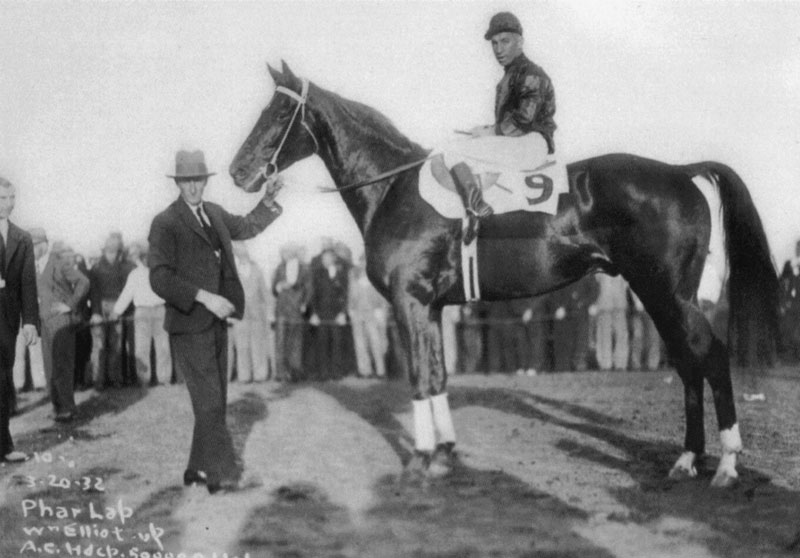
Phar Lap
Phar Lap in the winners' circle after the $50,000 Agua Caliente Handicap. Pictured are trainer Tommy Woodcock and jockey Billy Elliot.

Fourteen days after this great victory, Phar Lap would die under mysterious circumstances at a ranch in Menlo Park,California. Emotionally stirred by this tragedy, many believed the great horse was poisoned, but in reality Phar Lap died of a rare form of colic.

The Agua Caliente Handicap was caught in the rigors of the Depression, and the purse was reduced to $25,000. The 1933 and ’34 runnings were won by Gallant Sir, ridden by George “The Iceman” Woolf and John “Red” Pollard of Seabiscuit fame, respectively. 1935 saw the end of the great racetrack in Tijuana as a new president of Mexico, Lazaro Cardenas, sought to close the gambling empire run by Americans. It was not until 1938 that both Agua Caliente racetrack and its signature race joined forces in an effort to revitalize racing in Northern Mexico. Seabiscuit made his only start outside of the United States as he scored an easy win in the $12,500 race.

With the opening of Santa Anita in 1934 and the lifting of Prohibition, Agua Caliente racetrack no longer had the stronghold it had during the early 1930’s. Agua Caliente was reduced to an arena for lower level horses but remained a popular attraction for horseplayers during the 1950’s and 60’s. Caliente offered a varied betting menu, which made its Anglo neighbors seem drab in comparison. With Quinellas, Perfectas and the 5-10 (racing’s first pick-6) Caliente lured the American bettors into Mexico for the only Sunday racing in the Western region.

Run by John Alessio, Caliente saw an opportunity to make racing history by reviving the Agua Caliente Handicap and luring the great Round Table. At the time, Round Table was $30,000 short of being racing’s newest millionaire, and the winning share of the Agua Caliente Handicap would put Round Table over that mark.

Round Table winning Agua Caliente Hcp
Round Table winning the 1958 Caliente Handicap.

Assembling a host of local runners, Caliente assured trainer William Molter that Round Table would not carry more than 130 pounds. More than 30,000 people crammed into Caliente that day. Round Table, ridden by William Shoemaker, had a close call on the clubhouse turn as Shoemaker found himself in a tight running position. But “Shoe” was able to get the big horse out in the clear and won the race with a decisive move on the far turn. Round Table won by nine lengths in track-record time for the 1-1/16-mile distance.

Round Table winners circle
Round Table in the winners' circle with trainer William Molter, Jockey Bill Shoemaker and Caliente General Manager John Alessio.

After the 1958 running, the Agua Caliente Handicap would never be run again. While the Santa Anita Handicap has seen monumental growth from its birth in 1935, the great race has its roots and owes its very concept to the great tracks of Tijuana, Mexico.

Author's Note: Agua Caliente was destroyed in a 1971 fire. Rebuilt, the “new” Caliente opened in 1974 and eventually closed its doors in 1992. Today Caliente is no longer the racetrack it used to be and has been converted into a private home of a failed local politician, its infield retrofitted with a soccer stadium.

All photographs property of David Beltran Collection.


David J. Beltran was born in Chula Vista and raised in San Diego and Tijuana. He has been attending the races since he was an infant, both at Caliente and the Southern California race tracks. Beltran is the author of the book The Agua Caliente Story (Eclipse Press 2004), a correspondent to Caballo, a racing magazine in Mexico, and a writer for the Argentine racing daily, Turf Diario. He recently published an article in HorsePlayer magazine covering betting on South American imports. Beltran also breeds Thoroughbreds and is a blood-stock agent specializing in Argentinean racing and breeding stock. He lives in Chula Vista with his wife, daughter, and two dogs.